Let’s understand how a wardrobe is divided and how we use each of the sections.
The wardrobe basically has 3 sections, which are:
wardrobe
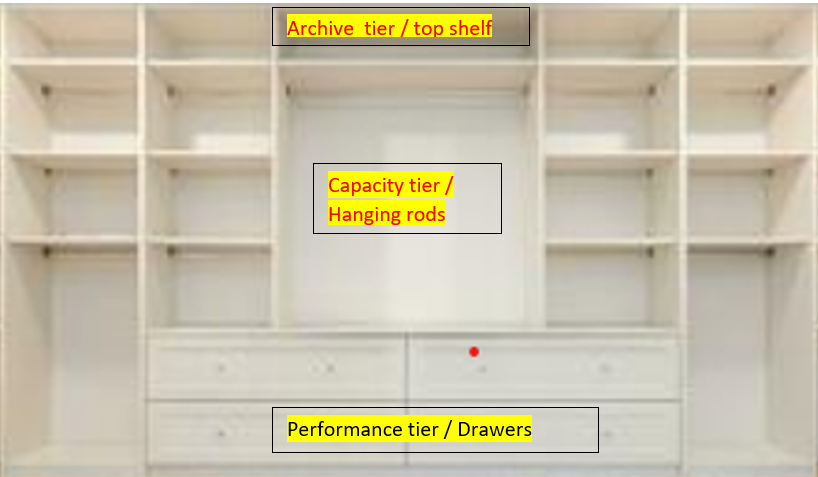
- Drawers
- Hanging rods
- A large spacious shelf that sits at the top of the wardrobe.
Now let’s look at their uses:
Drawers, we usually store small items and those that we use very frequently, such as socks and lingeries.
Hanging rods, we store slightly larger items, but with less frequent use compared to the drawers, such as shirts, pants, and blouses.
Shelf that sits at the top of the wardrobe, we store those items that we occasionally use, such as travel bags, blankets for very cold weather.
So, now comes the relationship with the SOBR (Scale-out Backup Repository).
SOBR
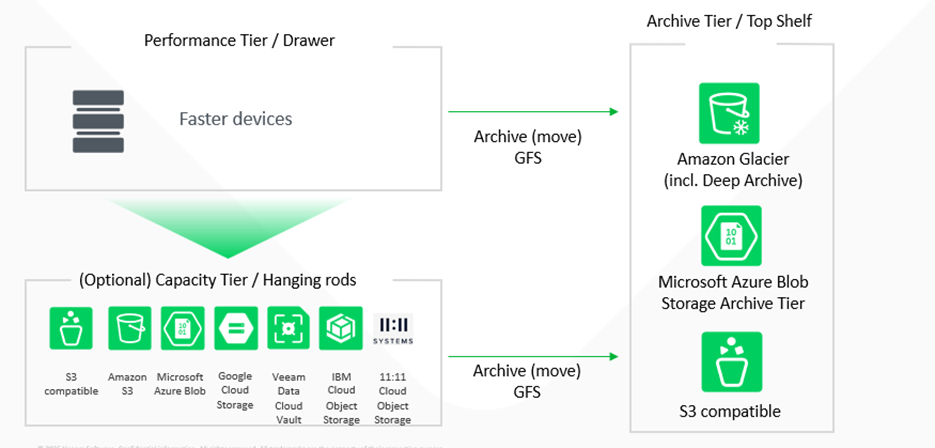
The SOBR has three tiers, they are:
Performance tier, which it is used to store data that is used most frequently (like our drawers to store socks, lingerie, etc.)
Capacity tier, it is used to accommodate backups with less frequent access (like our Hanging rods to store pants, shirts, and blouses)
Archive tier, it is used to accommodate things that we almost never or never use (suitcases, blankets for intense cold, or even those clothes that we are still unsure if we will ever use again), how about accessing the highest shelf, in my case, with my height, I need a small ladder, with two steps to access it, so to access it is more difficult and slower)
like the wardrobe, we are taking our clothes from or put them into the drawers, hanging rod or top shelf, moving them between “tiers”
So, this is one way I have to explain the concepts of tiering.
But of course, after going through these concepts, I will certainly deep dive into detail how the performance, capacity, and archive tiers collaborate with each other.
Using that analogy, we can talk about latency, media costs, links, performance and more.
Hope you enjoy the analogy!